Kazakhstan and Japan Expand Cooperation in Generation IV Reactor Safety Research
03 June 2026
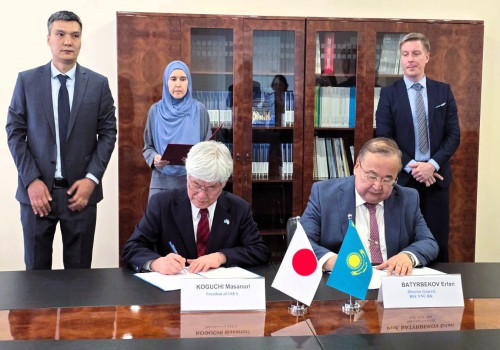
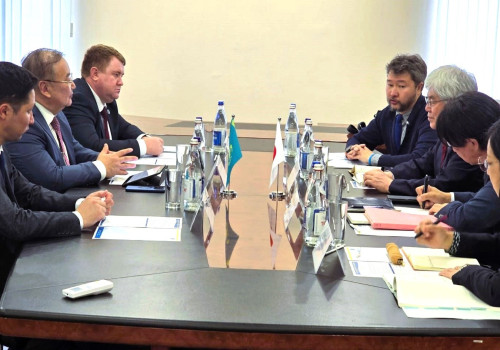
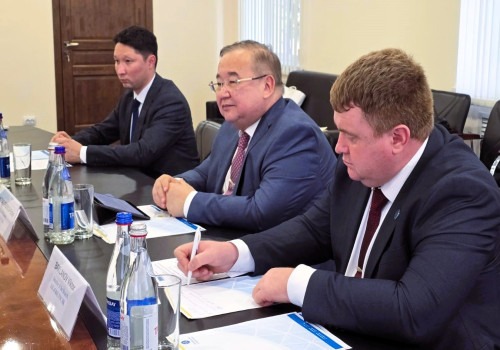
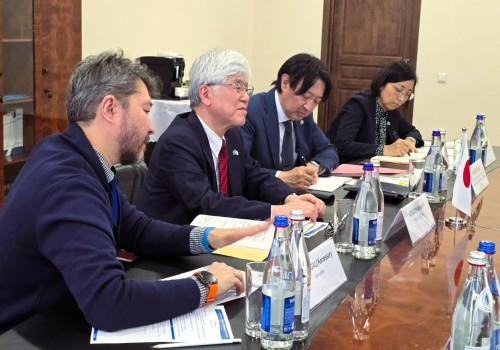
In Almaty, Professor Erlan Batyrbekov, Director General of the National Nuclear Center of the Republic of Kazakhstan (NNC RK), met with Mr. Masanori Koguchi, President of the Japan Atomic Energy Agency (JAEA). During the meeting, the parties discussed their joint achievements and prospects for further cooperation in fast reactor safety research.
A key focus of the discussions was the continuation of the joint EAGLE project on experimental safety studies of fast reactors, as well as the signing of a Memorandum of Cooperation between JAEA and NNC RK and an Agreement on the implementation of the first phase of the further cooperation.
The EAGLE project has been jointly implemented by NNC RK and JAEA since the early 2000’s. It is aimed at advancing the safety of sodium-cooled fast reactors, including the investigation of phenomena associated with severe accidents involving core melt.
The project includes studies of molten core material behavior and its interaction with sodium coolant and structural materials through both in-pile and out-of-pile experiments. In-pile tests are conducted at the unique IGR research reactor, while out-of-pile studies are performed at the EAGLE test-bench.
Over the past 20 years, the project has produced significant results. Approximately 200 preparatory tests have been carried out, along with 2 intermediate-scale and 9 full-scale reactor experiments, as well as more than 65 out-of-pile tests at the EAGLE test-bench. The EAGLE, EAGLE-2, and EAGLE-3 experimental programs have been successfully completed. In addition, with the support of Marubeni Utility Service, Ltd., analytical and computational studies were performed to prepare the next phase of the EAGLE program (the Post-EAGLE-3 project).
The next logical step in this long-standing cooperation is the EAGLE-4 project, which includes several in-pile experiments, twelve out-of-pile experiments, and a series of small-scale tests. The main objectives of this new phase are to test fuel assemblies for advanced Japanese Generation IV reactors, conduct research at the IGR reactor and other NNC RK facilities, and provide the scientific basis for the safety assessment of advanced nuclear technologies.
The results of the EAGLE-4 project are expected to make a substantial contribution to the development of scientific approaches for ensuring the safety of advanced Japanese-designed fast reactors. They will also create additional opportunities for strengthening Kazakhstan–Japan cooperation in the peaceful uses of nuclear energy.
At present, NNC RK and JAEA are discussing the continuation of the EAGLE-4 project through 2031.
Latest news by category:
-
Side Event “35th Anniversary of the Closure of the Semipalatinsk Test Site: From National Tragedy to National Pride”
17 September 2026
-
Kazakhstan Advances International Fusion Energy Partnerhips
16 September 2026
-
ITER and NNC RK Discuss Expanding Cooperation on Controlled Thermonuclear Fusion
15 September 2026
-
Vienna Hosts Discussion on Development of Cooperation Between NNC RK and Idaho National Laboratory
15 September 2026