
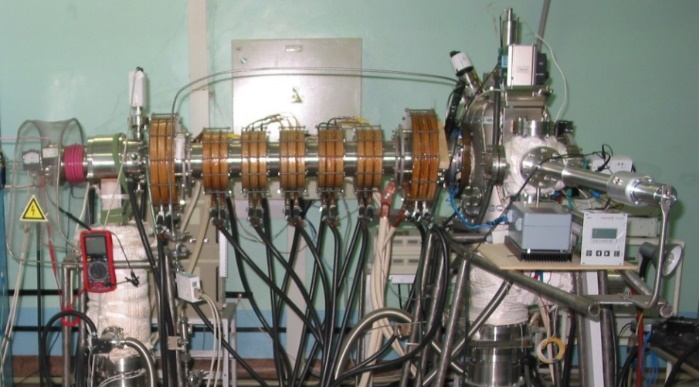
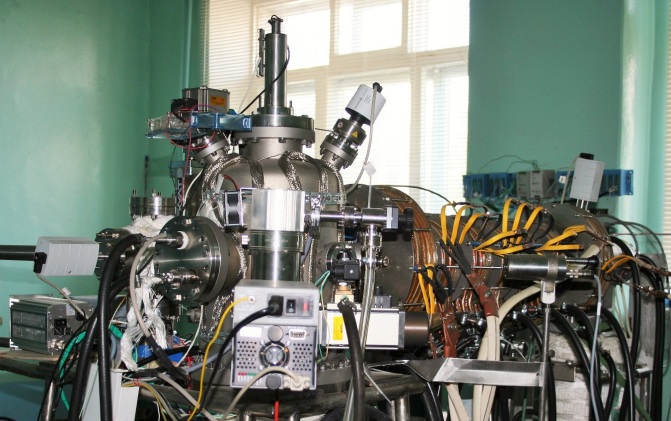
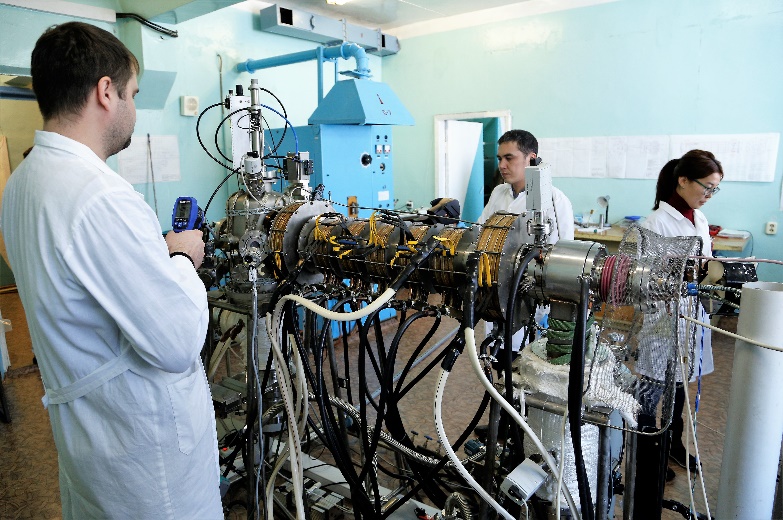
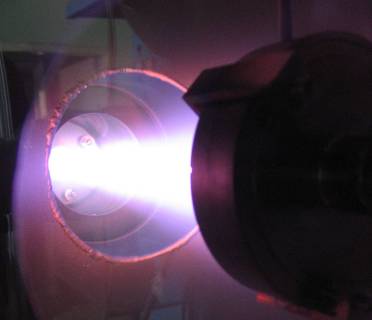
The simulation test-bench with a plasma-beam installation is intended for testing structural materials of thermonuclear technology under conditions of plasma exposure and high thermal load. The diagnostic equipment of the test-bench allows studying the plasma-surface interaction and plasma physics.
The imitation test-bench has the following distinctive functionalities:
- electron beam scanning system, which allows to distribute the heat flux of electrons over the area of the cooled collector of the target assembly;
- several target vacuum devices with the ability to cool and control the temperature of the sample from the irradiated and back sides of the surface;
- system for programmed heating of the test materials for experimental work on thermal desorption in situ analysis.
Main research area:
- study changing the structure and properties of structural materials of thermonuclear facilities under plasma irradiation and thermal exposure;
- modification of the material surface layer in order to improve performance;
- testing of diagnostic equipment for thermonuclear facilities under plasma exposure and heat load in various gaseous mediums;
- investigation of the interaction between low-temperature plasma and materials of the TNR divertor cladding and the first wall of the KTM Tokamak and TNR;
- obtaining protective coatings on the surface of TNR structural materials;
- improvement of methods and tools for diagnostics of low-temperature plasma.
Technical specification:
- Electron source power
- 0-30 kW
- Electronic temperature
- 0-15 eV
- Electron energy
- 0-20 keV
- Electron beam diameter
- 3-30 mm
- Maximum gas pressure
- <10⁻³ torr
- Plasma ion energy
- 0-2 keV
- Ion flux density
- 10²² m⁻²·s⁻¹
- Maximum plasma concentration H₂, D₂
- ~1·10¹⁸ m⁻³
- Maximum plasma concentration He, N₂, Ar, O₂
- ~1·10¹⁸ m⁻³
The imitation test-bench with plasma-beam installation is capable to use hydrogen, deuterium, helium, argon, nitrogen, oxygen, air and a mixture of gases as working gases.